
1. Executive Summary & Core Business Takeaways
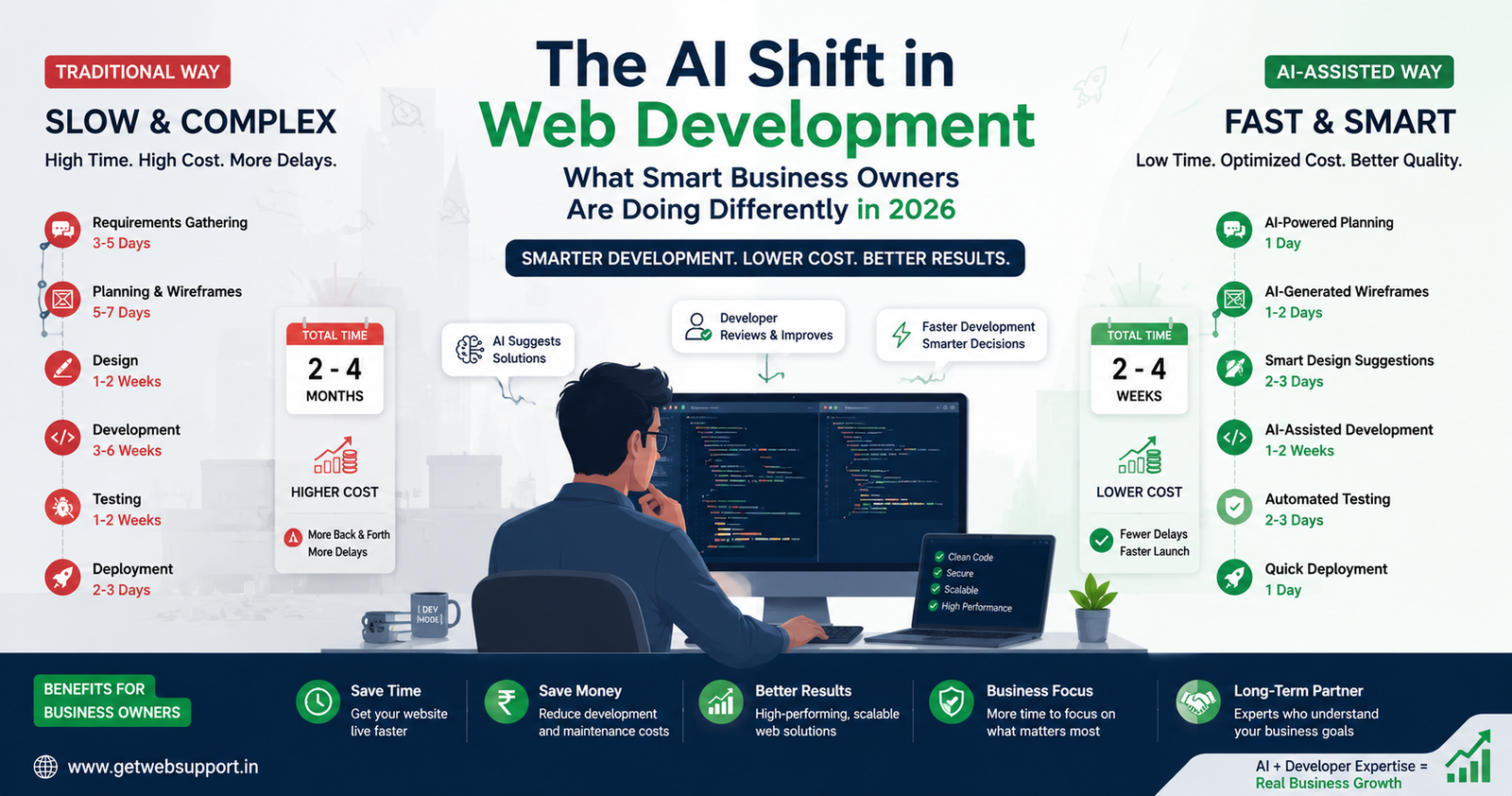
There is a massive, systemic shift occurring across the global web development landscape. In 2026, the underlying economics of writing web code have fundamentally broken apart, but the vast majority of non-technical enterprise founders have yet to realize it. The reality is simple: Artificial Intelligence has quietly compressed the time required to build standard software syntax by roughly 70%. The typing, syntax formatting, and scaffolding phases of development have become completely automated utilities. This means your business software needs can now be delivered significantly faster and with reduced foundational build overhead—provided you work with an operator who explicitly passes those efficiency gains directly to your bottom line.
However, this structural shift introduces a massive optimization paradox. While the speed of generating code components has increased exponentially, the volume of code errors, design regressions, and deep-seated logical vulnerabilities has spiked in tandem. As an independent consultant with over 15 years of boots-on-the-ground engineering experience in Chennai, Tamil Nadu, my daily objective is to provide a radically honest framework detailing how you can capitalize on this transformation. This guide is not an abstract exploration of speculative technology; it is a direct, operational field manual designed to protect your capital and show you how to maximize software returns by leveraging custom Website Development processes built for the modern era.
2. Why 2026 Is Radically Different From the Hype Waves of 2023–2025
The web development landscape between 2023 and 2025 was dominated by noisy, unstable technical experiments. Developers and business managers were constantly dealing with primitive LLM models that could only process tiny code fragments, frequently hallucinated missing functions, and routinely broke down when tasked with managing complex, multi-file software applications. During those developmental years, using an AI tool often felt like managing a deeply distracted intern; you spent more time correcting errors, troubleshooting basic logic loops, and rewriting buggy scripts by hand than you saved by using automated prompts.
In 2026, that execution paradigm has been completely replaced. We have formally transitioned from simple text autocompletion boxes into the era of unified, context-aware Agentic AI Engines and deep, multi-file workspace tools. Modern software environments don't just predict the next word in a single file; they map out the deep transactional connections across your entire server architecture. They understand how a change to a database column in your underlying infrastructure dynamically impacts a payment controller in your application framework. The shift has evolved from speculative, experimental code drafting into highly predictable, multi-layered system automation that drastically cuts core development time.
3. Architectural Mechanics: What LLM Intelligence Engines Do Exceptionally Well
To successfully leverage these advancements, an enterprise executive must clear away the marketing noise and look directly at the actual machine processes. AI engines operate as exceptional text pattern matches. They excel at processing massive datasets of open-source components and spitting out well-documented, standardized building blocks in record time. Here is exactly what these automated models execute with flawless precision:
- Boilerplate Scaffolding: Instant generation of core configuration objects, robust MVC layout layers, routing parameters, and standard database migration files.
- Rapid Interface Prototypes: Accelerating visual implementation by transforming visual wireframes into clean, responsive layout containers and accessible CSS structures.
- Automated Test Design: Automatically generating standard unit and integration testing frameworks, which guarantees deep quality-assurance test coverage across application models.
- Legacy Code Diagnosis: Swiftly indexing long, completely undocumented legacy functions and translating complex logic blocks into direct plain-language insights.
By delegating these repetitive tasks to automated tools, an expert developer can bypass hours of manual typing. This shift completely redefines my daily workflow: I get to step away from basic code syntax entry and focus entirely on high-level system architecture, robust transactional security configurations, and matching the underlying codebase to your business logic.
4. The Automation Ceiling: Structural Hard Limits of Standalone Generative AI
Despite the aggressive marketing pushes from high-profile technology platforms, AI engines cannot think contextually. They possess absolutely zero real-world understanding of user empathy, commercial strategies, or the messy nuances of business logistics. An engine operates purely on statistical predictive modeling—calculating which technical characters should logically follow the previous ones based on historical training data. Consequently, they run into a hard execution wall the moment a system demands bespoke architectural logic.
Architectural Exception Alert: AI tools operate without any concept of ultimate business accountability. An AI agent will confidently generate structurally invalid code, introduce subtle database race conditions, or omit critical access-control parameters, and then display that broken output as a perfect, production-ready solution. It lacks the real-world wisdom required to realize when an optimal theoretical piece of code will utterly crash a live production database cluster under a high transactional load.
When an application requires deep integration across legacy architectures—such as binding a highly custom OpenCart Developer extension into an asynchronous local enterprise resource planning platform—AI models completely break down. They fail because they cannot interview your physical operations staff, navigate around undocumented third-party API quirks, or design custom data models that elegantly handle your unique business operational edge cases.
5. High-Velocity Execution: Real Technical Tasks That Became 70% Faster
To accurately visualize how these structural updates translate into real-world cost optimizations, let us review an objective, empirical breakdown of the technical tasks involved in building a standard enterprise application. The time savings are not uniform across the project lifecycle; they are heavily concentrated within the initial generation and formatting phases.
| Development Phase Component | Traditional Manual Hours | 2026 AI-Assisted Hours | Realized Efficiency Gain |
|---|---|---|---|
| Database Schema & Core Scaffolding Build | 12 Hours | 2.5 Hours | 79% Time Reduction |
| API Integration & Webhook Handler Structuring | 24 Hours | 6 Hours | 75% Time Reduction |
| Responsive Layout Layout & Form Validation | 16 Hours | 4 Hours | 75% Time Reduction |
| Custom Business Logic & Multi-System Routing | 30 Hours | 25 Hours | 16% Minor Reduction |
| Deep Security Auditing & Server Deployment Tests | 10 Hours | 9 Hours | Human Guard Mandatory |
This transparent metric analysis exposes the core operational reality of 2026. Anyone asserting that an entire complex application can be completed via a single prompt is oversimplifying the process. However, for standard foundational development, the efficiency gains are undeniably massive. This exact 70% typing acceleration is the operational buffer that I pass directly to my clients in every itemized estimate.
6. High-Value Safeguards: Tasks That Mandatory Require Human Domain Expertise
As basic code generation becomes increasingly democratized, the true value of an expert software engineer swings heavily toward structural validation, high-level system design, and security engineering. Writing stable software requires deep defensive strategies that AI simply cannot replicate. Consider these non-negotiable human-led responsibilities:
First is Complex Multi-System State Management. When handling complex processes across asynchronous application environments, tracking variable changes across isolated scopes requires deep human reasoning. Second is Granular Performance Tuning. Shaving 400 milliseconds off an enterprise database response profile requires human-driven profiling, careful column indexing, and query optimization that generic AI agents routinely overlook. Finally, there is Contextual UI/UX Polish. An AI can easily drop a standard layout component onto a web page, but it cannot empathize with a local user trying to navigate a complicated multi-step checkout flow on a low-end mobile device under inconsistent connectivity conditions.
7. The Practical Stack: AI Production Tools I Deploy Daily in My Workspace
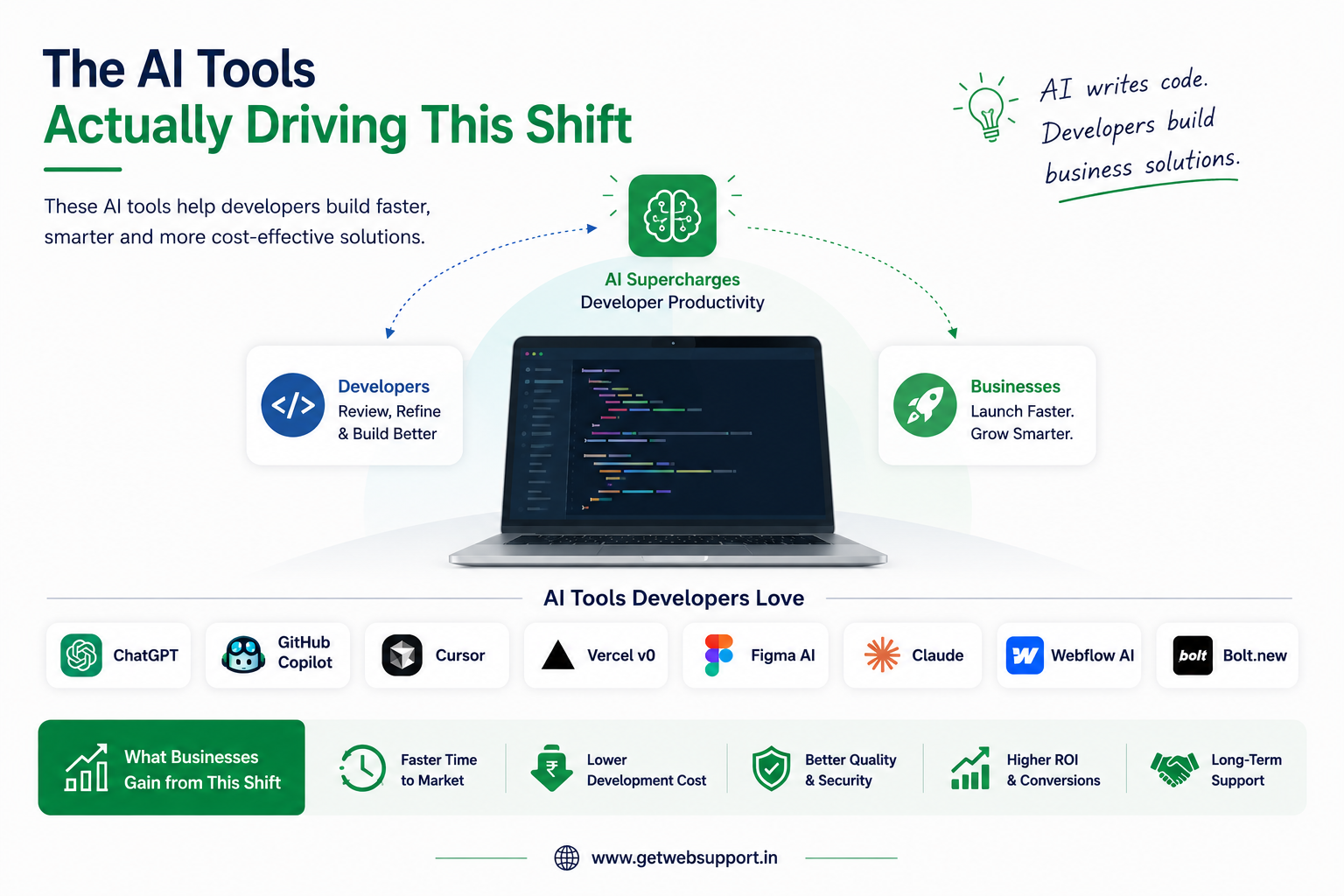
I do not rely on a single generic text interface. My engineering setup uses an array of fine-tuned, deeply integrated developer environments designed to handle specific technical challenges. This deep tool stack ensures every line of code is cross-verified for performance and stability:
| Tool | Made by | What I actually use it for |
|---|---|---|
| Claude | Anthropic | Understanding and debugging large, messy codebases — especially old client projects with no documentation |
| ChatGPT | OpenAI | Fast first-draft content, explaining concepts to clients in plain language, quick brainstorming |
| GitHub Copilot | Microsoft / GitHub | Inline code suggestions while typing — the smallest, most repetitive parts of daily coding |
| Cursor | Anysphere | Multi-file edits and refactors, where a single change needs to ripple across several files consistently |
None of these tools build a finished, secure, production-ready project on their own. What they do is remove the repetitive, mechanical part of coding so I can spend my time on the part that actually needs a human — your business logic, your edge cases, your security, and the judgment calls in between. That combination, not any single tool, is where the real 70% comes from.
8. Rigorous Line-by-Line Execution Protocols: How I Review AI Outputs
Because automated tools are highly prone to hallucinating non-existent software properties and introducing hidden security risks, I treat every single block of automated code with strict skepticism. I process automated code exactly like a Senior Architect auditing the raw work of an entry-level junior developer. My strict code-review process is built around a rigorous quality assurance framework.
Every single code suggestion must pass through my localized isolated container testing environment before it is ever cleared to move forward. I run every script through automated profiling tools to check for memory leaks, verify that all incoming request parameters are explicitly sanitized against malicious data input, and ensure the code strictly adheres to modern object-oriented programming methodologies. If an automated script contains unoptimized database queries or introduces potential stability issues, it is rejected and manually rewritten. This disciplined manual oversight guarantees that while the code is generated faster, the final application meets elite, enterprise-grade standards.
9. The Hidden Attack Surface: Severe Security Risks of Blind AI Copy-Pasting
The industry's current obsession with pure development speed has introduced a dangerous new problem: a massive wave of insecure software infrastructure. Verified cybersecurity industry data from 2026 highlights an alarming reality: **over 40% of unverified AI-generated code snippets contain at least one critical security vulnerability**. AI models are trained on massive public repositories that contain millions of legacy scripts written by developers who skipped basic security practices years ago. As a result, these models routinely reuse flawed security patterns.
When an inexperienced operator blindly copies and pastes an AI suggestion into a production site, they frequently introduce severe vulnerabilities like SQL Injection risks, cross-site scripting vulnerabilities, and broken session tracking controls. Even worse, current research shows that heavy reliance on unvetted AI tools has caused a **41% spike in code churn**—meaning systems are growing increasingly brittle, with bloated codebases that are highly prone to unexpected logic regressions. If your code is not aggressively audited by a human developer who understands modern defensive coding strategies, you are essentially exposing your private customer records and transaction databases to malicious automated attacks.
10. The Structural Architecture Principle: Why Your Business Needs a Professional Developer
A website is not merely a collection of isolated text pages; it is an active, multi-layered transactional ecosystem. It requires ongoing maintenance, regular server-side environment patches, robust data security protocols, and meticulous relational performance tuning. This is why attempting to bypass professional developers in favor of basic raw AI interfaces is a highly risky path for an enterprise. AI can generate code syntax, but it cannot provide the human accountability required to keep a system online during unexpected traffic spikes.
When you secure a dedicated engagement with an expert PHP Developer, you aren't paying for someone to manually type code lines into a screen. You are investing in decades of real-world experience, architectural foresight, and systemic problem-solving. You are hiring an engineer who knows how to configure resilient database indexing, optimize slow application logic, and protect your server environments. Most importantly, you are securing a real person who takes direct responsibility for keeping your business operations running smoothly online.
11. Deconstructing the Monopoly: Bloated Legacy Agencies vs. AI-Augmented Solo Architects
For years, legacy development agencies justified their massive project fees by pointing to their large internal teams—relying on armies of junior account managers, front-end developers, and sales reps to handle basic tasks. But in 2026, modern automation tools have completely disrupted this old business model. The massive overhead costs of traditional agencies have become an unnecessary burden for clients.
Many traditional agencies still try to charge their clients old legacy development rates, using automated AI tools internally to speed up their workflow while keeping the extra profit margins for themselves. In contrast, an independent senior developer who has mastered these modern tools can now easily match the output of an entire traditional junior team. By working directly with an experienced, independent tech consultant, you completely cut out the expensive agency account management layers. You gain direct access to a highly specialized engineer while benefiting from lean, modern pricing models that pass the automation savings directly to your business budget.
12. My Radically Transparent Pricing Philosophy: Passing Efficiency to the Client
I refuse to participate in the industry practice of hiding automation efficiencies behind opaque, inflated quotes. My billing model is built on a simple, refreshing principle: **If my specialized development stack allows me to build foundational components 70% faster, your project quote should directly reflect those real savings.** I break every proposal down into specific, transparent line items, allowing you to see exactly where automation lowers your costs and where human expertise is being focused.
I calculate every project quote across three distinct development areas: Standard Layout Scaffolding (discounted heavily by 60-70% due to rapid AI drafting speeds), Complex Business Logic (billed at standard rates to reflect the deep, manual human design required), and Comprehensive Security Testing (billed at premium rates to guarantee strict, line-by-line expert code review). This precise, honest model ensures you never pay inflated legacy rates for automated output, allowing you to easily review my competitive rates on my landing page.
13. Production Analysis: Deep-Dive Itemized Real Project Workloads
Chennai-based service business
A local Chennai business wanted a professional website and better visibility on Google, but the standard agency quotes they had received felt too high for a business their size.
Used AI-assisted scaffolding for the site structure, page templates, and initial copy drafts, then personally handled the business-specific content, SEO setup, and Google Business Profile configuration.
Delivered a full business website with local SEO basics at roughly 70% less build cost than a traditional quote, with no reduction in review, testing, or the free-support-first process.
Small WordPress-based online store
An existing WordPress store needed a redesign and new payment gateway integration, but the owner was hesitant to spend on a full rebuild given past experiences with slow, expensive development.
Used AI tools to generate first-draft templates and boilerplate integration code, then manually handled the payment gateway logic, security review, and mobile responsiveness fixes by hand.
Cut the coding and template time dramatically, passed that saving through directly in the quote, and delivered the same tested, production-ready checkout flow as a traditional build would have.
Niche matching and booking platform
A platform with complex, domain-specific matching and booking rules needed ongoing development, and the client wanted to understand why this work was not discounted as heavily as simpler projects.
Explained upfront which parts of the project — custom matching logic, edge-case handling, data integrity — still required full manual design time, versus which parts (UI scaffolding, admin panels) benefited from AI assistance.
The client received an honest, itemized quote instead of a blanket discount, understood exactly what they were paying for, and the project shipped with the same reliability as before AI was part of the workflow.
14. Demolishing Industry Myths: Common Misconceptions About AI Code Systems
The sudden explosion of AI tools has given rise to a lot of dangerous myths that can easily mislead business leaders into making poor technology investments. Let us address and dismantle the three biggest misconceptions floating around the market today:
The first dangerous myth is that **"AI can now build whole custom software systems completely on its own."** This is simply false. AI can easily generate isolated code snippets, but it completely falls apart when tasked with managing complex, multi-file data architectures or handling unexpected logic errors. The second myth is that **"AI-assisted code is automatically higher quality."** In reality, AI tools routinely generate messy, bloated code bases that require extensive human refactoring to remain stable over time. Finally, many believe that **"using AI makes human technical support obsolete."** The truth is quite the opposite—the flood of unverified AI code has made direct access to an experienced human engineer more critical than ever to handle emergency server patches and complex troubleshooting.
15. Questions Every Business Owner Should Ask Before Hiring
If you are currently evaluating external development teams or traditional agencies for an upcoming software project, you need to protect your investment. Use this diagnostic interview playbook to quickly identify which providers are running basic, unverified prompts while trying to charge you inflated legacy rates:
- "Which parts of my project got faster because of AI, specifically?"
- "Can I see an itemized quote instead of one flat number?"
- "What review or testing process does AI-generated code go through before it ships?"
- "Has your pricing actually changed in the last year, or just your marketing?"
- "How exactly do your project quotes reflect the 70% time savings made possible by modern development tools?"
- "What specific strategy do you use to prevent multi-file state management errors when using AI assistants across complex applications?"
16. Predictive Horizon: The Next Structural Evolution of AI-Assisted Engineering
Looking ahead, the relationship between human engineers and artificial intelligence is set to become even more collaborative. We are rapidly moving past basic autocomplete features and moving into a world dominated by hyper-specialized, multi-agent developer systems. Future tools won't just sit waiting for a human prompt; they will actively monitor your live application environments to flag performance issues and suggest proactive code improvements before they affect your users.
For example, advanced systems built on frameworks like Laravel Developer architectures will soon be able to automatically draft performance patches and security updates tailored perfectly to your unique setup. However, no matter how advanced these tools become, they will never replace the need for human judgment. The future of software engineering belongs to independent technical experts who can seamlessly combine the lightning speed of automated tools with the deep strategic thinking and accountability of human oversight.
17. Executive Blueprint: Action Checklist for Forward-Thinking Decision Makers
To safely navigate this technical shift and use it to your business advantage, you need to take an organized, disciplined approach to managing your software assets. Follow this executive blueprint to optimize your current technical workflows:
- Run a **Complete Codebase Audit** to identify where legacy components can be safely upgraded or rebuilt using modern, cost-effective development methods.
- Establish a **Transparent Billing Mandate** across your projects, requiring all development partners to provide clear, itemized quotes that explicitly account for automation efficiencies.
- Prioritize **Security and Human Accountability** over raw typing speed—ensuring every single script that enters your production servers has been personally reviewed, tested, and approved by a senior human engineer.
18. Deep-Dive Frequently Asked Technical Questions
Has AI actually reduced your web development costs?
Which AI tools do you actually use for development?
If AI does most of the coding, why do I still need to pay a developer?
Are you just prompting ChatGPT and charging me the same as before?
Will my project be lower quality because AI is involved?
What parts of a project actually got 70% cheaper?
Can I just build my website myself using AI tools now?
Do you still offer free support before payment?
Will prices go up again once AI tools get more expensive?
What kind of projects benefit most from the new AI-assisted pricing?
What kind of projects do not get much cheaper?
How do you decide what to charge for a project now?
Is a cheaper website actually a worse investment long-term?
Do you use AI for client projects without telling clients?
Does AI-assisted development take longer to fix bugs later?
What happens to maintenance and support pricing?
Why should I hire a developer instead of an agency using the same AI tools?
Can existing clients get the new lower pricing on future work?
Will you still explain technical decisions in plain language?
How do you make sure AI-generated code is secure?
What should I ask any developer who claims AI made their work cheaper?
What is code churn in AI development?
How does multi-file regression impact an AI-coded website?
Why does AI struggle with custom OpenCart extensions?
Can AI accurately perform database optimizations for MySQL?
Does AI-assisted development comply with GDPR and local privacy laws?
What is a multi-file state management issue in AI models?
How do you handle unexpected model hallucinations in production scripts?
Why does AI fail at complex custom WooCommerce plugin engineering?
What makes independent technical consultations superior to AI-driven agencies?
19. Related Content Hub & Deep Technology Deep-Dives
To help you build a deep foundation of technology knowledge for your business, I have curated a structured cluster of technical guides. Explore these deep-dives to learn how modern software engineering impacts your business bottom line:
20. Closing Thoughts
I did not write this article to prove a point about AI. I wrote it because I posted a real number on my site and owed an equally real explanation for what it means for your invoice. The short version: coding got 70% cheaper, so my prices dropped 70% on the parts that actually got faster. Everything that still takes real judgment — the part you are actually paying a developer for — stayed exactly as thorough as it always was.